The OBH Matrescence Framework
Becoming a mother can feel disorienting, overwhelming, and unexpectedly complex.
You might find yourself thinking:
Why do I feel like this?
Why don't I feel like myself?
Why does this feel harder than I thought it would?
Many mothers are supported to cope but not to understand what is happening to them.
The OBH Matrescence Framework offers a different way of making sense of this experience.

What is the OBH Matrescence Framework?
The OBH Matrescence Framework understands becoming a mother as a profound process of identity transformation, one that affects how you see yourself, how you relate to others, and how you experience the world around you.
It recognises that becoming a mother is a profound shift that affects how you see yourself, how you relate to others, and how you experience the world around you.
Rather than focusing on symptoms alone, this approach helps you make sense of the deeper changes taking place, internally and externally, as you move through this transition.
Where this framework came from
Nine years ago I began working with mothers. What I didn't expect was how often I would hear the same quiet, bewildered question underneath everything else: why do I feel like this?
Not a crisis. Not a breakdown. Just a persistent sense of being lost inside an experience that everyone around them seemed to think should feel straightforward.
I trained as a coach, and later as a psychotherapist. And the longer I worked, the clearer it became that what mothers needed wasn't just support, it was understanding. A way of making sense of what was happening to them, not just a way of managing it.
The OBH Matrescence Framework draws on everything I have seen, heard, and sat with over nearly a decade of supporting mothers through one of the most significant transitions of their lives. It is not a textbook model. It is something that emerged from the work itself.
A framework for understanding the transition to motherhood
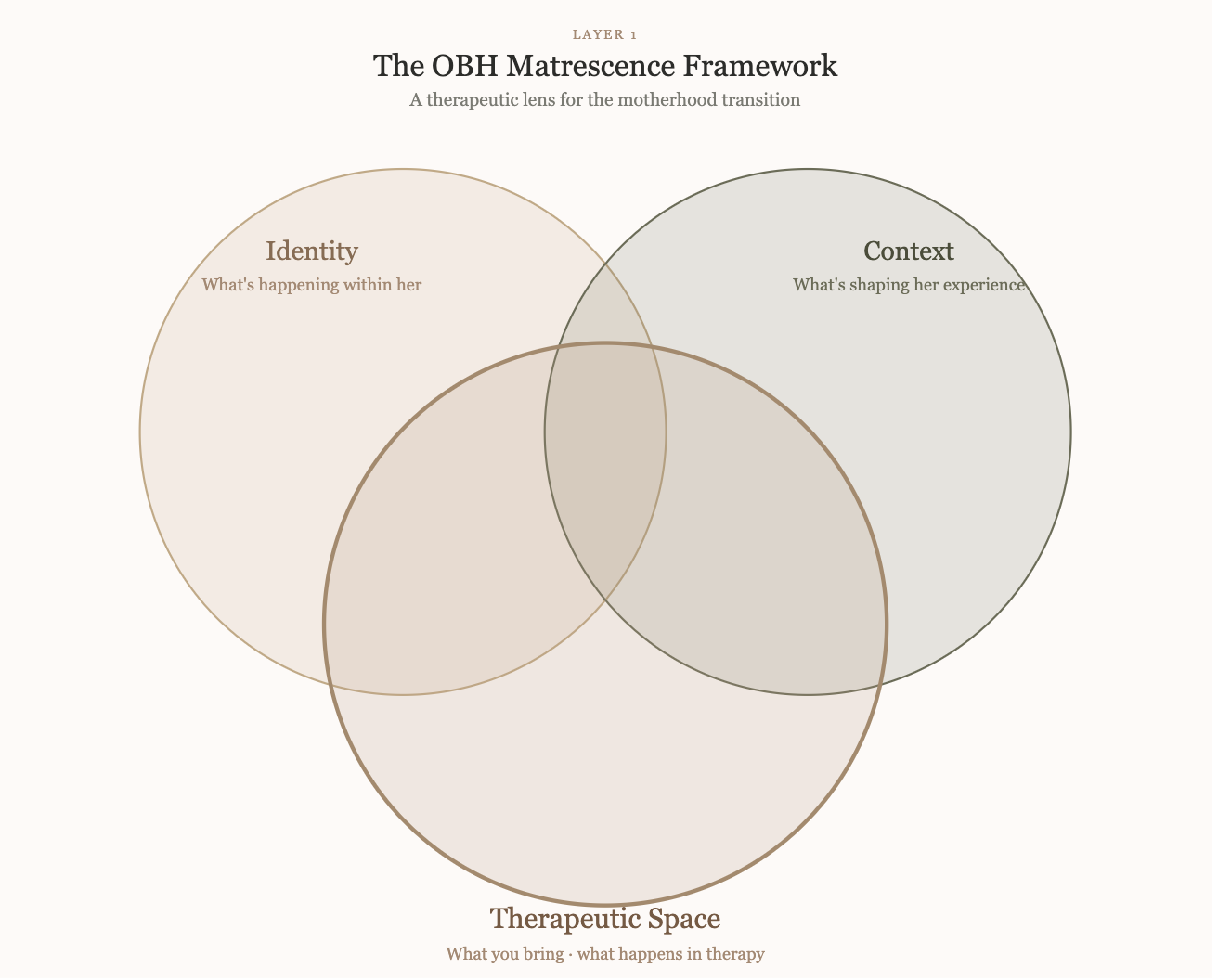
Layer 1:
This model represents three core domains that shape the experience of becoming a mother.
Identity
The internal experience of becoming
Loss of self
Fragmentation
Reconstruction
Motherhood can disrupt your sense of who you are.
You may feel unlike yourself, pulled in different directions, or unsure how the person you were fits with the mother you are becoming.
Context
The conditions shaping the experience
Unrealistic expectations
Relational strain
Invisible labour
This experience does not happen in isolation.
It unfolds within a wider context of societal pressure, shifting relationships, and the often unseen mental and emotional load of motherhood, all of which shape how this transition is lived and felt.
Therapeutic Space
How the experience is held and understood
Non-pathologising
Meaning-making
Integration
Therapy offers a space to slow this down.
A space where your experience is not reduced to a diagnosis, but understood in context.Where we make sense of what is happening, rather than trying to fix it. Where different parts of your experience can begin to come together.
Why this matters
Without a framework like this, many mothers are left feeling that something is wrong with them.
In reality, much of what you are experiencing makes sense in the context of becoming a mother. When that isn't named, or when it's treated as a mental health problem to be managed, it can deepen feelings of shame, isolation, and self-doubt.
This framework offers another way.
Layer 2:
The diagram below adds the nine elements that sit within each circle.
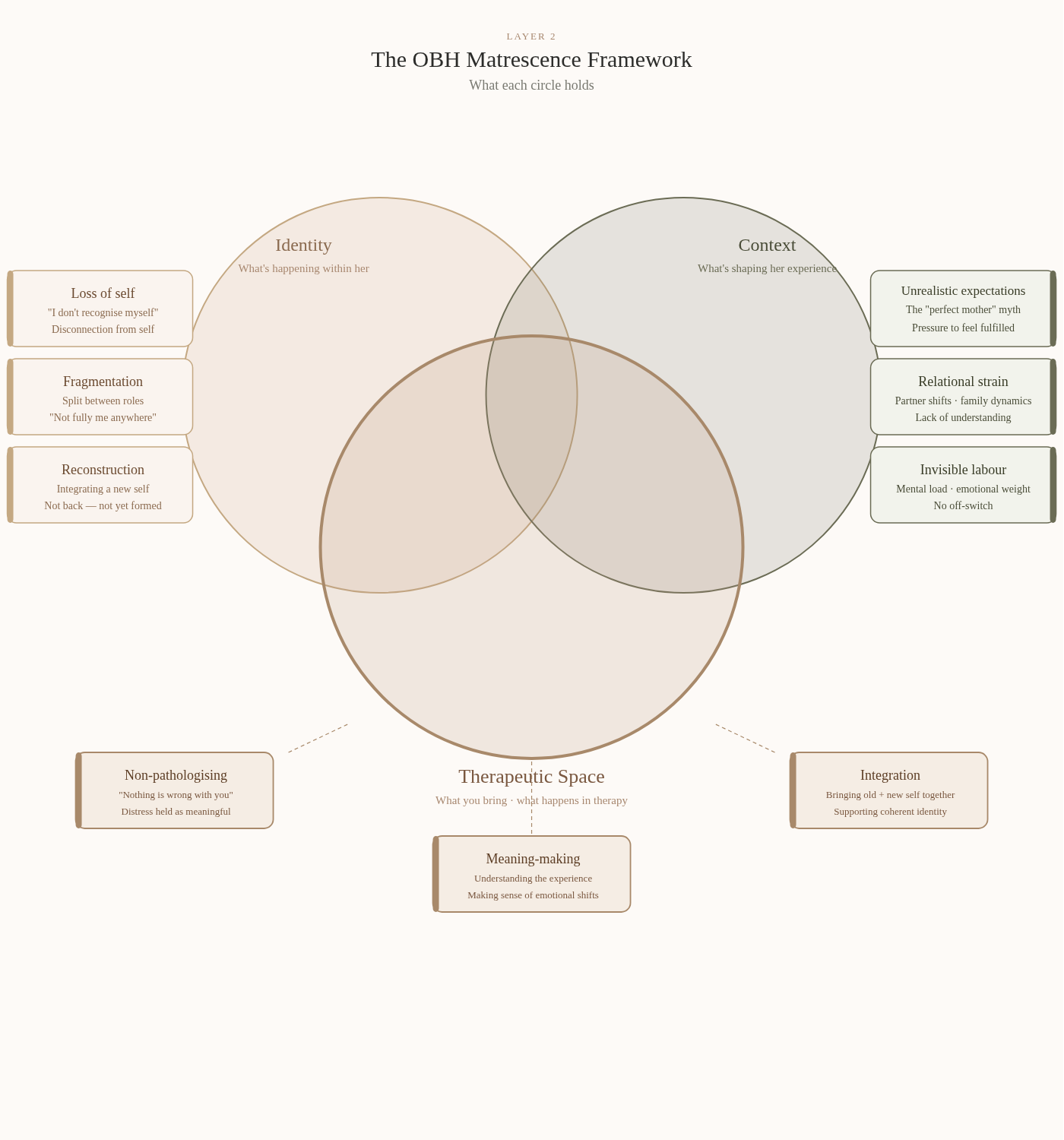
These are not a checklist or a diagnosis. They are the most common things I see mothers carrying, named here so that if you recognise yourself in any of them, you know you are not alone in it.
Layer 3:
This layer shows what happens where the circles meet.
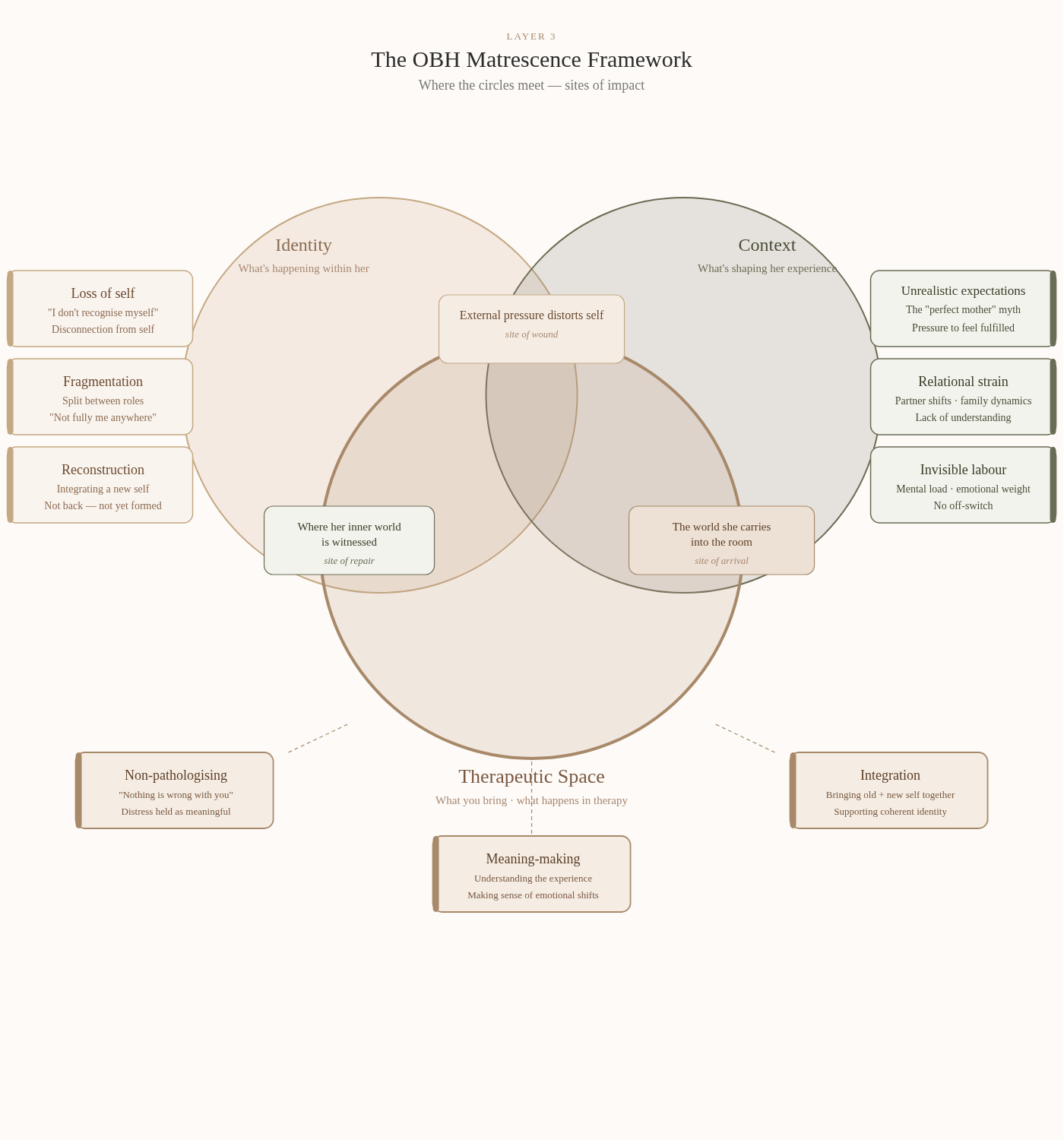
Where the circles meet, something happens. These overlapping zones are sites of impact, where identity meets the world around her, where the world she carries enters the therapeutic space, and where her inner world is finally witnessed.
Layer 4:
And finally, the complete picture.
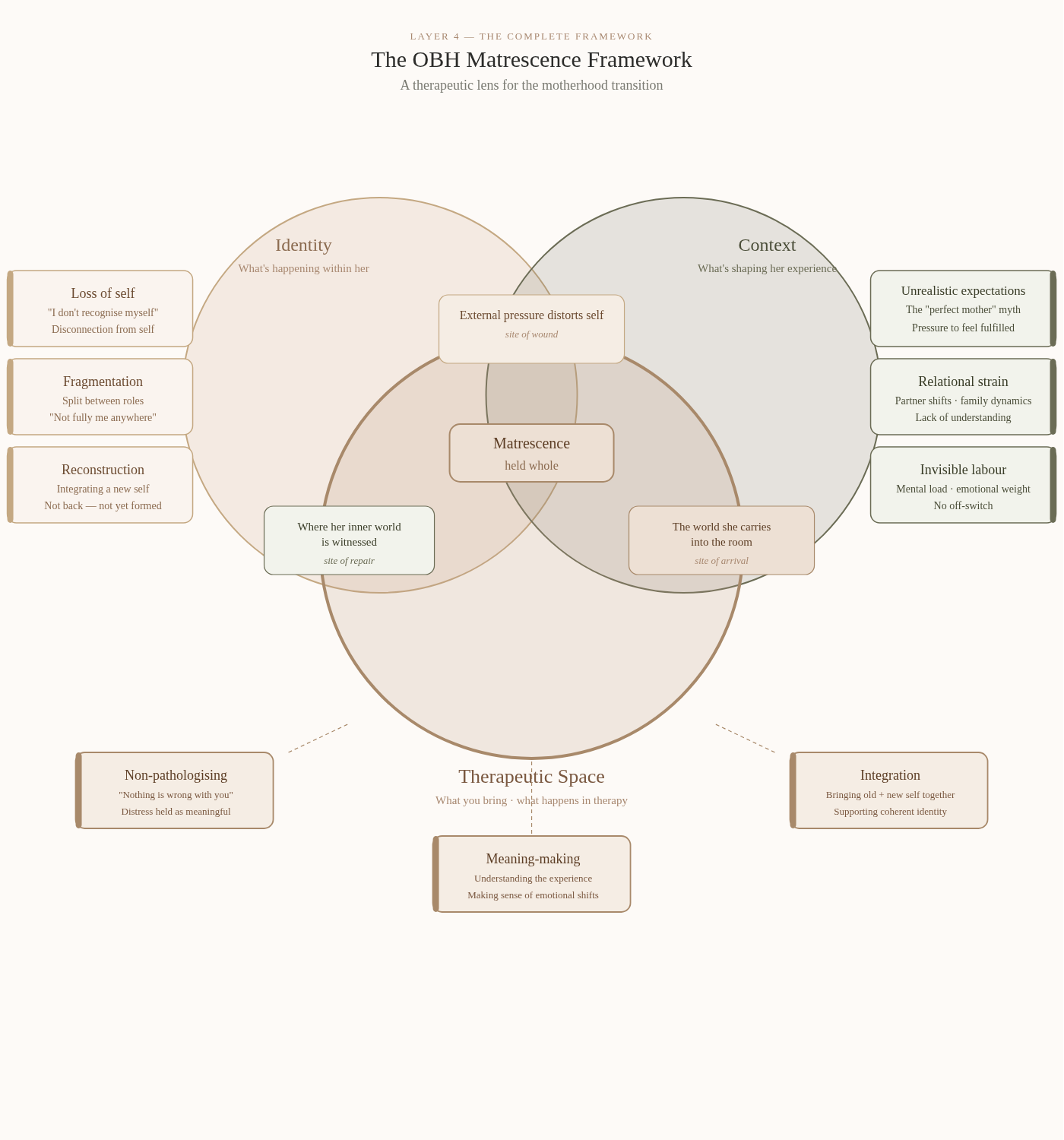
This is the OBH Matrescence Framework held whole.
At the centre, where all three circles meet, is matrescence itself. Not a diagnosis. Not a problem to be solved. But a profound, legitimate, and often unwitnessed transformation that deserves to be named, understood, and met with care.
This is the lens through which I work with every mother who comes to me. Whatever she is carrying, loss of self, invisible labour, the weight of impossible expectations, there is a place for it here. And there is a way to begin making sense of it.
What this means in our work together
Working within the OBH Matrescence Framework, we explore what is happening to you, not just how to manage it. We look at your sense of self, the pressures around you, and the complexity of what you are carrying. We make space for ambivalence. We don't try to fix you, because you are not broken.
This is not about returning to who you were before. It is about making sense of who you are becoming.

A different way of understanding motherhood
If you are feeling lost, overwhelmed, or unlike yourself, you are not alone.
And there is a way to begin making sense of this. Gently, at your own pace, in a space where your experience can be fully met
Want to understand the thinking behind this framework? Read about the theoretical influences that shaped it.